

Understanding How RF Systems Communicate
In the first part, we explored why RF fundamentals matter.
The next step is understanding how wireless systems actually communicate, and what happens between transmission and reception.
At a high level, RF systems are defined not just by what they send, but how they send and receive information.
Three Ways RF Systems Communicate
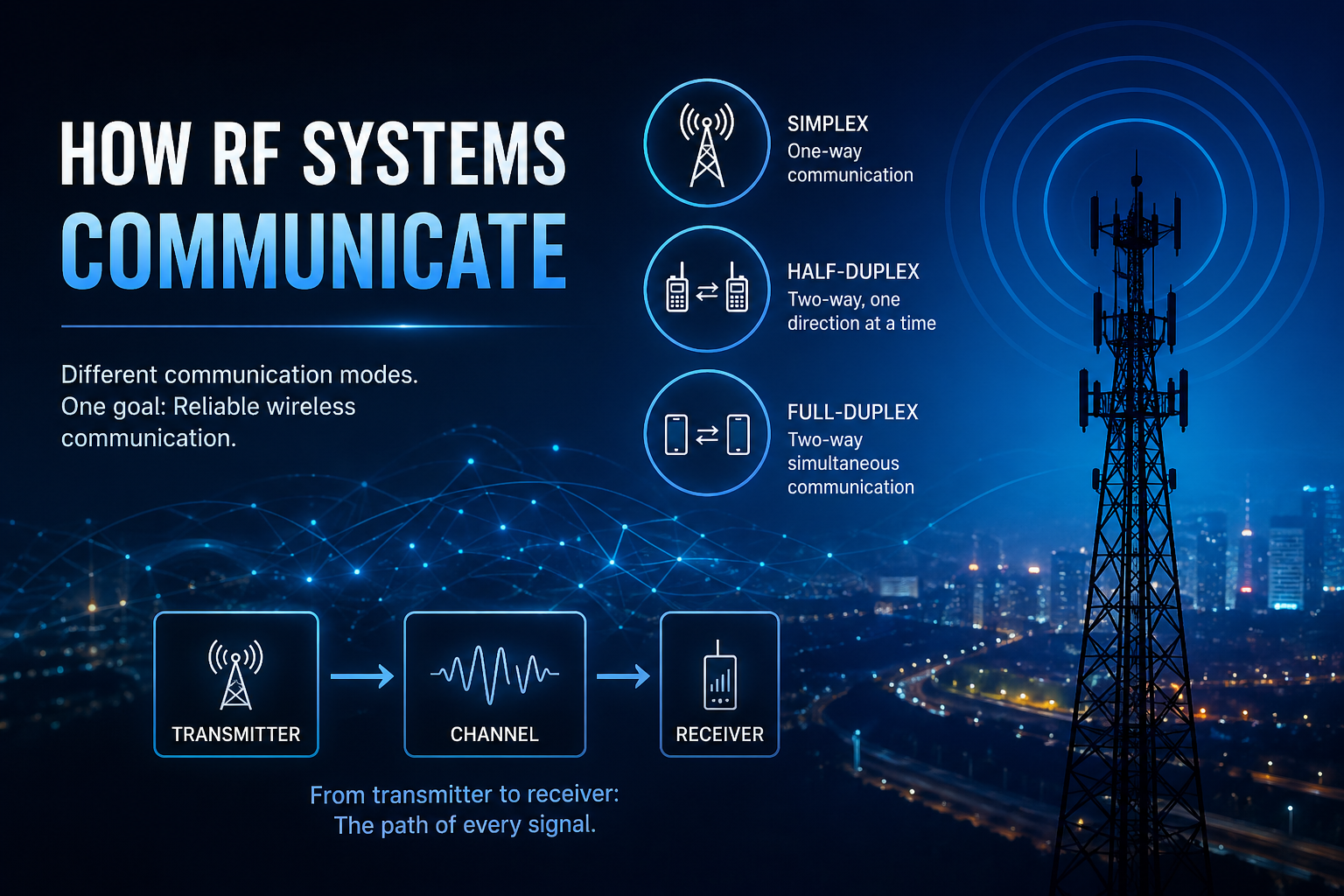
RF communication systems operate in three fundamental modes:
Simplex: One-Way Communication
Example: TV broadcasting is an example of simplex communication.
- Information flows in a single direction - from transmitter to receiver.
- Used in broadcast systems like radio and television, simplex is simple and efficient but does not allow feedback.
Simplex RF system


Half-Duplex: Two-Way, But Not Simultaneous
Example: Walkie-talkies use half-duplex communication.
- Devices can both transmit and receive, but only one at a time.
- This creates a turn-based communication model, commonly seen in walkie-talkies and similar systems.
Full-Duplex: Simultaneous Two-Way Communication
Example: Phone calls use full-duplex communication.
- Both devices can transmit and receive at the same time.
- This is typically achieved using separate frequencies and is used in systems like cellular communication.
What Happens Between Transmitter and Receiver?
Understanding communication type is only part of the story.
Every RF system follows a basic flow:
- Information is generated
- It is converted into a signal
- Transmitted through a channel
- Received and converted back into usable form
This process defines how data actually moves through a wireless system.

Carrying Information Over a Signal
A key challenge in wireless communication is this: The original information signal is usually low frequency, but it needs to travel over long distances.
To make this possible, the signal is combined with a high-frequency carrier. This process allows efficient transmission over the air.
This is where RF systems move from simple communication models to actual signal engineering.
 Modulation and Demodulation Concept
Why This Matters
The communication type defines how devices interact, while the transmission process defines how signals actually travel.
These communication models are already part of everyday life, from phone call, your Wi-Fi router, even a cricket stadium wireless mic system, all follow one of these communication models. Even a little RF engineering knowledge helps us better understand how the wireless world around us actually works.
Understanding these communication methods and signal flow helps explain how different wireless systems work, from simple broadcasting to real-time networks, and how information is transmitted through the air.
Stay tuned for Part 3, where we look at how signals are carried using modulation and demodulation.