

RF Communication: The Invisible Backbone of Modern Connectivity
RF communication powers the invisible backbone of modern connectivity, enabling devices to exchange information wirelessly across vast distances. This article introduces the core principles of RF, from electromagnetic waves and spectrum basics to how signals are transmitted, received, and measured in real-world systems.
1. The World Runs on Invisible Waves
Every time a message is sent, a device connects to Wi-Fi, or a GPS signal guides navigation, a quiet orchestration of electromagnetic waves carries information through space. RF communication operates in a region of the electromagnetic spectrum where signals can travel long distances, penetrate obstacles, and carry encoded information efficiently.
Unlike wired communication, RF removes the need for physical connectivity. It allows devices to communicate across rooms, cities, oceans, and even between Earth and space. Because of this capability, RF technology forms the backbone of wireless communication systems used in:
- Mobile communication networks
- Satellite communication
- Wireless IoT devices
- Bluetooth accessories
- Radar systems
- Medical devices
- Industrial automation
RF engineering focuses on how signals behave, how far they travel, how they interact with the environment, and how reliably they deliver information.
2. Understanding the Electromagnetic Spectrum
The electromagnetic spectrum represents the entire range of electromagnetic radiation, organized by frequency. RF occupies the portion of the spectrum between approximately 3 kHz and 300 GHz.
Different frequency ranges are suited for different applications due to their propagation characteristics.
Key RF bands include:
- VHF (Very High Frequency): 30–300 MHz – FM radio, TV broadcast
- UHF (Ultra High Frequency): 300 MHz–3 GHz – Mobile phones, GPS, Wi-Fi
- SHF (Super High Frequency): 3–30 GHz – Radar, satellite communication
- EHF (Extremely High Frequency): 30–300 GHz – mmWave 5G, advanced sensing
Industrial, Scientific and Medical (ISM) bands are particularly important because they allow unlicensed wireless communication. Popular ISM frequencies include:
- 433 MHz
- 868 MHz (Europe)
- 915 MHz (USA)
- 2.4 GHz (global)
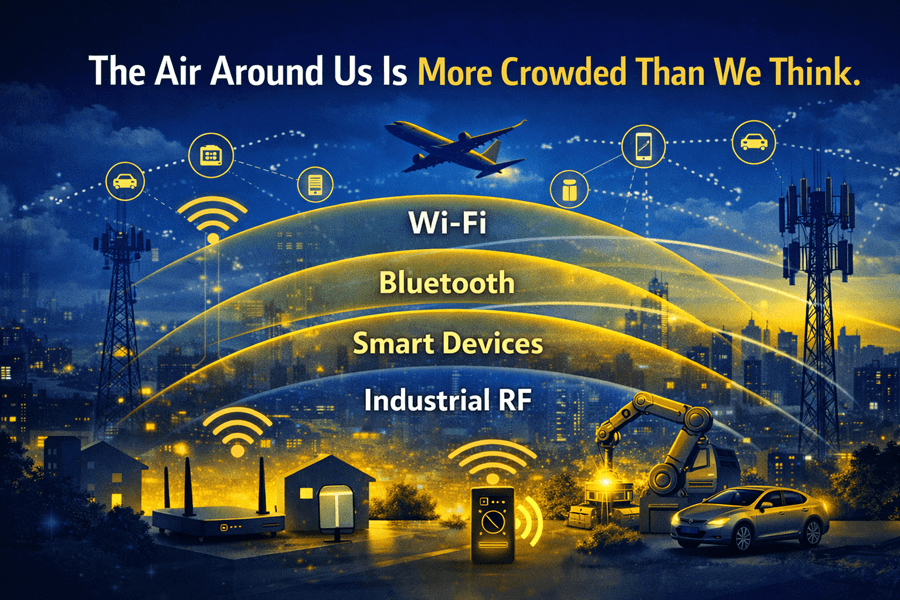
Devices such as Wi-Fi routers, Bluetooth headphones, ZigBee modules, and microwave ovens share the 2.4 GHz band. As a result, interference management becomes critical in RF design.
3. Measuring Signal Strength: dBm and dB
RF engineers rarely describe signal strength using watts directly. Instead, logarithmic units such as dB and dBm are used because signal levels can vary across extremely large ranges.
Key definitions:
- dB (decibel) expresses ratios between two power levels.
- dBm expresses absolute power relative to 1 milliwatt.
Important relationships:
- 0 dBm = 1 mW
- 10 dBm = 10 mW
- 20 dBm = 100 mW
- −30 dBm = 1 µW
- −110 dBm ≈ extremely weak signal
Rule of thumb:
- A 3 dB increase corresponds to doubling of power.
- A 3 dB decrease corresponds to halving of power.
Because RF signals attenuate over distance and through obstacles, understanding signal strength measurement is essential when estimating communication reliability and coverage range.
Even extremely small signal levels can carry usable information. For example, −110 dBm corresponds to only microvolt-level voltage in a typical 50-ohm system.
This highlights how sensitive RF receivers must be in order to detect weak signals.
4. Frequency Allocation and Regulation
RF spectrum is a limited resource. Governments regulate frequency allocation to prevent interference between different technologies.
Different countries follow different regulatory frameworks:
- USA uses FCC regulations
- Europe uses ETSI standards
- Japan uses ARIB standards
For example:
- 433 MHz band is widely used in Europe for short-range devices such as remote controls and sensors.
- 915 MHz band is common in North America for industrial IoT systems.
- 2.4 GHz band is globally available, making it ideal for international products.
When designing wireless products, engineers must ensure compliance with regional regulations regarding:
- Output power limits
- Bandwidth usage
- Modulation type
- Spurious emissions
Failure to comply may prevent devices from being legally sold in certain markets.
5. Types of RF Communication Systems
RF systems can be classified based on how communication occurs between transmitter and receiver.
5.1 Simplex Communication
Simplex systems support one-way communication only.
Examples:
- FM radio broadcasting
- Television broadcasting
- Paging systems
In simplex systems, one device continuously transmits while another only receives. There is no feedback channel.
Simplex systems are simple to design and are efficient for broadcasting information to many receivers simultaneously.
5.2 Half-Duplex Communication
Half-duplex systems allow two-way communication, but only one device can transmit at a time.
Examples:
- Walkie-talkies
- Wireless keyboards and mice
- Industrial handheld radios
Communication alternates between transmit and receive modes using a shared frequency channel.
Half-duplex systems are widely used because they provide bidirectional communication while maintaining relatively simple hardware requirements.
5.3 Full-Duplex Communication
Full-duplex systems allow simultaneous transmission and reception.
Examples:
- Mobile phones
- Satellite communication systems
- Modern wireless infrastructure
Full-duplex communication typically uses separate frequencies for transmit and receive operations.
This approach enables continuous data exchange and is essential for real-time communication applications such as voice calls and video streaming.
6. Basic Model of Wireless Communication
All RF communication systems share a similar architecture.
Key stages include:
- Information Signal (Baseband Signal): Original data such as voice, sensor data, or digital information.
- Modulator: Embeds the information onto a high-frequency carrier signal.
- Transmitter: Amplifies the modulated signal and sends it through an antenna.
- Communication Channel: Medium through which the signal travels (air, space, obstacles).
- Receiver: Captures the transmitted signal.
- Demodulator: Extracts the original information from the received signal.
- Output Device: Speaker, display, processor, or control system.
Because RF signals travel through unpredictable environments, system design must account for noise, interference, signal reflections, and attenuation.
7. Why RF Basics Matter for Engineers
RF design influences critical performance characteristics:
- Range
- Battery life
- Data rate
- Reliability
- Interference tolerance
- Product certification
Even engineers who are not RF specialists benefit from understanding RF fundamentals because wireless connectivity is now embedded into nearly every modern electronic product.
A small design decision such as antenna placement or frequency selection can dramatically affect product performance.
Understanding RF basics helps teams:
- Choose appropriate wireless technologies
- Estimate achievable communication range
- Avoid costly redesigns
- Ensure regulatory compliance
- Optimize power consumption
RF engineering is also about practical trade-offs between cost, complexity, size, and performance.
This foundation sets the stage for a deeper dive into RF engineering. We’ll explore more concepts and practical aspects of RF engineering.
References
Technology for Innovators, Texas Instruments Inc., 2006 (PDF)